The Science
Why The Fly Cage Works — and Why Others Don't
Understanding fly biology is the key to effective control. The Fly Cage is engineered around how biting flies actually hunt — not how we assume they do.
Horse Flies Are Visual Hunters
Unlike mosquitoes, which primarily use scent and CO₂ to locate hosts, horse flies, deer flies, greenheads, and yellow flies are highly visual predators. They locate targets by detecting large, dark, moving objects — which in nature represent animals.
Female horse flies (only females bite) require a blood meal to develop and lay eggs. They are relentless hunters, capable of flying at speeds up to 25 mph and pursuing targets over considerable distances.
When a biting fly approaches a target and is disturbed, it has a characteristic escape behavior: it flies upward. This is the biological behavior that the Fly Cage exploits.
Chemical repellents and sprays work only temporarily and require constant reapplication. They do nothing to reduce fly populations. The Fly Cage eliminates flies before they reproduce — reducing local populations season after season.
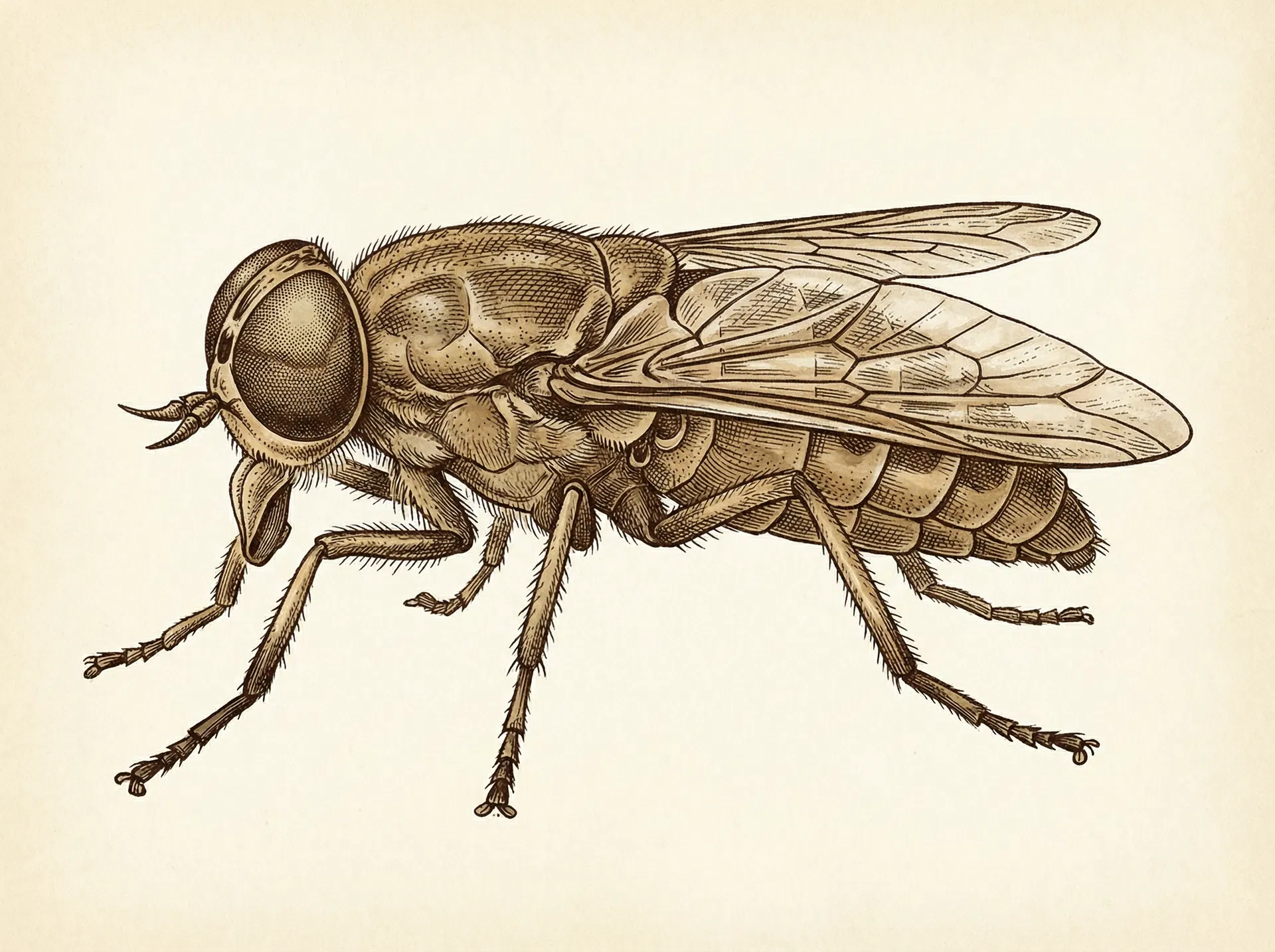
Tabanus species (Horse Fly) — visual hunter anatomy
How the Fly Cage Trap Works
The Black Lure Attracts Biting Flies
The Fly Cage features a large black ball suspended below the mesh cage. This lure mimics the visual profile of a large animal — exactly what biting flies are programmed to hunt. The lure moves with the wind, creating the motion cues that trigger a fly's attack response.
Flies Approach and Fly Upward
As a fly approaches the lure and is disturbed by the cage structure above, it executes its natural escape behavior: flying upward. This is an instinctive response that evolved to help flies escape from swatting tails and hooves.
Trapped Inside the Mesh Cage
Once inside the mesh cage, the fly cannot navigate back out. The mesh allows light and air to pass through, which disorients the fly and prevents escape. No chemicals, no electricity, no attractants are needed.
Population Reduction Over Time
By catching female flies before they can complete a blood meal and lay eggs, the Fly Cage interrupts the reproductive cycle. Over a full season, this results in measurably fewer flies in the area — a compounding benefit that chemical solutions cannot provide.

Placement for Maximum Effectiveness
The Fly Cage works within line of sight, covering approximately ½ acre. Placement is critical — here’s how to get the best results:
Open, Sunny Areas
Place in full sun where flies are most active. Avoid deep shade — flies hunt in bright light.
Near Activity Zones
Position near where flies are most problematic: pasture edges, pool areas, patios, or barn entrances.
Visible from All Directions
The lure must be visible to approaching flies. Avoid placing behind fences, walls, or dense vegetation.
Experiment with Location
Every property is different. Try 2–3 placements in the first week to find where fly pressure is highest.
Multiple Traps for Large Properties
For properties over half an acre, use multiple traps spaced across high-activity zones.
The Fly Cage vs. Other Methods
| Chemical-Free | Reduces Population | No Maintenance | Safe for Animals | |
|---|---|---|---|---|
| The Fly Cage | ✓ | ✓ | ✓ | ✓ |
| Chemical Sprays | ✗ | ✗ | ✗ | ✗ |
| Bug Zappers | ✓ | ✗ | ✗ | ✓ |
| Fly Strips | ✗ | ✗ | ✗ | ✗ |
| Repellent Sprays | ✗ | ✗ | ✗ | ✗ |